
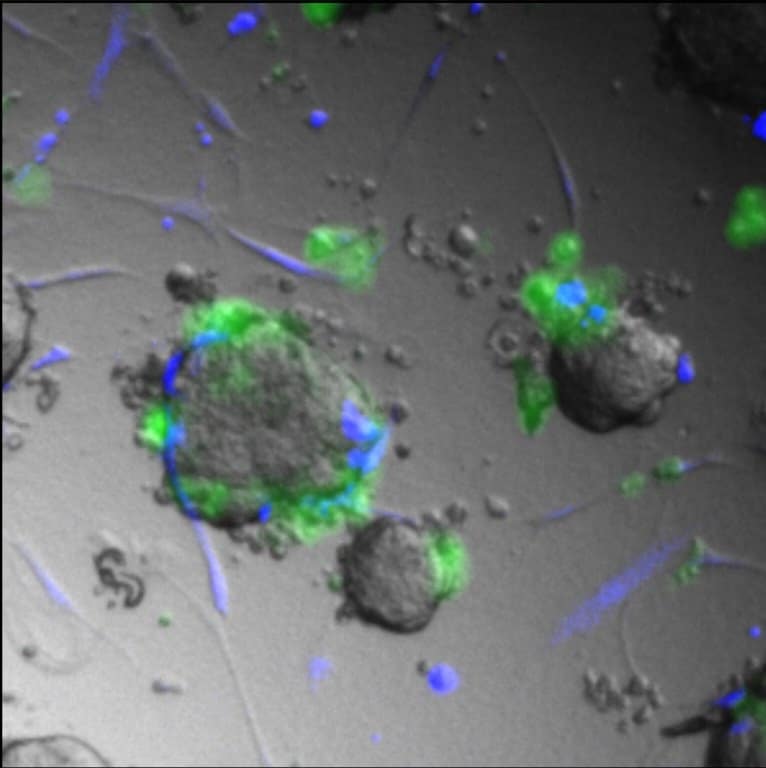
Oncosyne is developing a next-generation organ-on-a-chip co-culture module for pancreatic cancer through the INVICTA project, funded by The Research Council of Norway.
The project brings together Oncosyne, Professor Elena Rangelova at Sahlgrenska University Hospital, and Professor Stefan Krauss Deiml at the Hybrid Technology Hub (HTH), University of Oslo. The new module is based on HTH’s pump-less, recirculating Organ-on-Chip (rOoC) technology and is designed to recreate key interactions within the pancreatic tumour microenvironment.
Pancreatic ductal adenocarcinoma (PDAC) is characterised by a complex tumour microenvironment in which stromal cells, including cancer-associated fibroblasts, influence tumour progression and response to treatment. Conventional in vitro models often fail to capture these interactions, limiting their ability to predict clinical outcomes.
The new organ-on-a-chip module combines patient-derived pancreatic cancer tumoroids with relevant components of the tumour microenvironment to create a more physiologically relevant model for evaluating drug response and resistance. Together with Oncosyne’s iCAN platform, the technology is being developed to provide deeper insights into patient heterogeneity, mechanisms of resistance, biomarker discovery, and combination treatment strategies.
Later this year, the organ-on-a-chip module will be evaluated alongside the core iCAN platform in a co-clinical study to assess its predictive performance. This technology development complements the ongoing expansion of Oncosyne’s pancreatic cancer clinical programme, strengthening the company’s translational research platform and supporting the development of more predictive preclinical models for precision oncology.
Oncosyne gratefully acknowledges funding from The Research Council of Norway and thanks its collaborators at Sahlgrenska University Hospital and the Hybrid Technology Hub, University of Oslo, for their continued partnership in advancing this work.